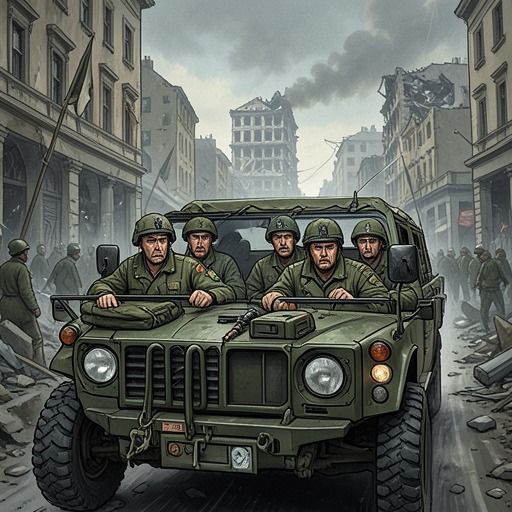
Dragging of a dead U.S. soldier through the streets
Black Hawk DownThe dragging of a dead U.S. soldier through the streets became one of the most widely seen images of the aftermath of the fighting in Mogadishu. The episode was witnessed at close range by Somali lawyer Bashir Haji Yusuf and later replayed on television, where it confronted American soldiers and the public with an image of loss that military commanders could not answer with an immediate recovery operation.
Setting and aftermath
After the shooting, Bashir went to Bakara Market to observe and photograph what remained. The dead had been removed from the streets, but the surrounding damage was still visible: dead donkeys lay on the road, and buildings near the crash site closest to the Olympic Hotel had been badly damaged. The scene was not an isolated encounter between a crowd and a soldier; it belonged to a city already marked by the battle’s destruction and mounting deaths.
That wider setting included sharply different experiences of the same fighting. American helicopters had fired on Kassim Sheik Mohamoud’s garage in southern Mogadishu, killing two of his employees. In the streets, Ali encountered people fleeing amid gunfire, including women and children, as militiamen used megaphones to call residents to defend their homes. Kassim’s small burial convoy reached the cemetery just before dusk, where people were digging graves for the newly dead. These events do not identify the soldier or the people involved in the dragging, but they establish the grief, fear, and anger surrounding the episode.
The pressure on civilian life was also reflected at Volunteer Hospital. Surgeon Abdi Mohamed Elmi was exhausted and covered in blood after wounded people began arriving the previous evening. At first they came only in small numbers, despite the heavy gunfire, because burning roadblocks and low-flying American helicopters made many people afraid to venture out. The hospital, the cemetery, and the streets form a wider record of the battle’s consequences alongside the image that would travel farthest.
Bashir’s witness
Bashir stayed at the edge of the angry crowd and took several photographs. He saw people take the American soldier’s body from a wheelbarrow and drag it through the dirt. Women shouted curses; men shouted and laughed. Bashir wanted to intervene, believing that respect for the dead was required by the Koran, but feared what might happen to him if he approached the men with the ropes. He remained back, followed the crowd for several blocks, and then left for home.
His position matters to the account: he was neither a participant in the crowd’s actions nor a detached observer untouched by them. He recorded what he saw, felt that it should be stopped, and nevertheless judged that intervening would put him at risk. The narrative preserves that limit on his agency rather than turning him into a rescuer or assigning him control over events. His photographs provide evidence of his witnessing, while his decision to withdraw registers the danger of confronting a crowd described as consumed by anger and revenge.
The image reaches the United States
On Monday, October 4, Americans awoke to reports of eighteen dead soldiers, more than seventy wounded, and hundreds of Somalis dead. Television showed the image of a dead American soldier being dragged through the dusty streets of Mogadishu. At the hangar, Rangers and Commando soldiers watched footage of Somalis celebrating on the rotor blades of Super 64 before the broadcast showed the dragging. The men gathered in a back room as the scene replayed; no one spoke, and some turned away.
The sequence joined two images of the aftermath: people on the wreckage of Super 64 and the dead soldier being dragged. For the exhausted, bandaged, and bruised servicemen watching, the broadcast made a distant street scene immediate. For viewers in the United States, the television images brought the battle into public view the following morning. The episode’s significance in the narrative thus lies not only in what happened in the street, but also in how recorded images carried the event beyond the people who had been there.
The decision not to recover the body
Some pilots wanted to return, land, and recover the body by force. The commanders refused. A large crowd surrounded the soldier, and they judged that an attack would become a massacre. The footage therefore prompted an impulse to act, but the visible circumstances imposed a limit: recovering one body could expose many people in the crowd to lethal danger. The account presents the decision as a command judgment made in response to the immediate situation, not as indifference to the dead.
That restraint contrasts with the silent anger of the men watching the replay and with Bashir’s wish, constrained by fear, to stop the dragging himself. Each response is bounded by a different form of power and risk: Bashir could document but not safely intervene; the pilots could act but were prevented by commanders concerned about the crowd; the watching soldiers could only witness the broadcast. The scene leaves the body’s recovery unresolved in these passages. Its lasting narrative force comes from the collision of grief, public imagery, and the danger of answering one act of violence with another.